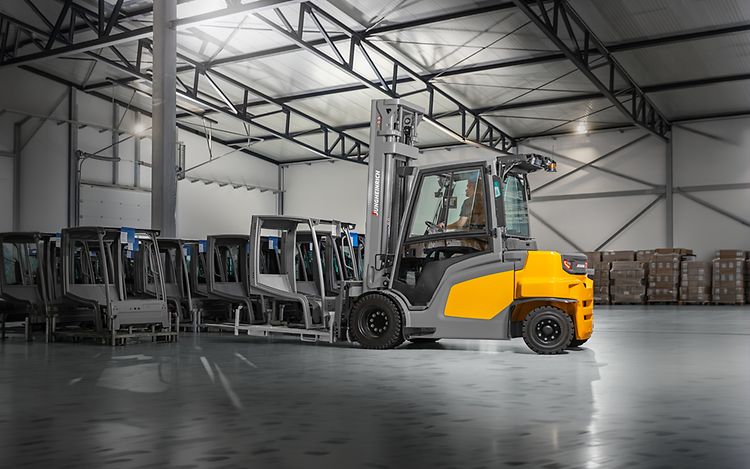
Navigating the production floors autonomously: Jungheinrich automates material handling at Tsubakimoto Europe
With two mobile robots from Jungheinrich, Tsubaki is automating internal goods transport at its European headquarters in Dordrecht. The solution connects goods receipt, a narrow-aisle warehouse, a production area and a new outbound conveyor into a seamless material flow.
- More ergonomic, more efficient transport processes within the existing narrow-aisle warehouse
- Seamless material flow connecting goods receipt, warehouse, production area and dispatch
- Uninterrupted mixed-traffic operation thanks to 3D obstacle scanner
- Smooth WMS integration ensures full process transparency
Hamburg / Dordrecht – Tsubakimoto Europe B.V. has entrusted Jungheinrich to automate internal goods transport at its Dordrecht site. The Dutch headquarters of the Japanese chain manufacturer will deploy two EKS 215a automated guided vehicles to connect five stations across a travel path of approximately 130 metres. The existing manual narrow-aisle warehouse remains in operation and will be integrated step by step into the automated material flow.
Two EKS 215a vehicles serve 98 positions across five stations: a goods-receipt buffer with 25 locations, 48 pick-and-drop (P&D) stations at the racking, a production area with fifteen inbound and eight outbound locations and two positions on the new outbound conveyor. The vehicles are designed for two-shift, 17/5 operation. Lithium-ion batteries with an automatic charging station ensure uninterrupted operation. A 3D obstacle scanner maintains safety during mixed-traffic operation alongside manual industrial trucks and pedestrians.
Automated to customer specification
As the load carriers at the site were not designed for automated transport, Jungheinrich advised Tsubaki on the design of custom load carriers – a prerequisite for enabling all five types to be transported automatically. Project preparation was complemented by a workshop on the Jungheinrich Logistics Interface, through which the EKS 215a vehicles are connected to the customer’s warehouse management system. The integration of the new outbound conveyor closes the process chain from goods receipt to dispatch.
"Automating our transport processes is the logical next step for us to remain competitive and relieve our employees of physically demanding routine tasks. The fact that Jungheinrich supported us as a partner throughout – including the development of the custom load carriers and the WMS integration – and with only minimum interruption of our ongoing operations during implementation, has reinforced our decision," said Jim Nederhand, Logistics Manager, Tsubakimoto Europe B.V.
"Many companies hesitate when it comes to automation because they fear having to significantly restrict or halt their ongoing operations in the process. The Tsubaki project demonstrates that this need not be the case. Even an organically grown warehouse with heterogeneous load carriers can be automated gradually and without interruption," said Christiaan Middelbrink, Project Manager Technical Sales at Jungheinrich Nederland.
Commissioning of the system is planned for early 2027.