At this point we would like to offer you the possibility to get in touch with us via chat. Due to your current cookie preferences, we cannot show the chat yet.
Please accept our “Preferences” cookies to activate the chat function.
For Jungheinrich, circular business models are the path of the future. They combine resource and energy efficiency and offer great potential for sustainability in ecological, social and economic terms. Here, too, we strive to be a pioneer for sustainable material handling.
Why we commit to the circular economy model
Everyone talks about it – we show why circular economy is more than just a trend topic for Jungheinrich.
Ecological Impact
Circular economy saves resources and reduces emissions
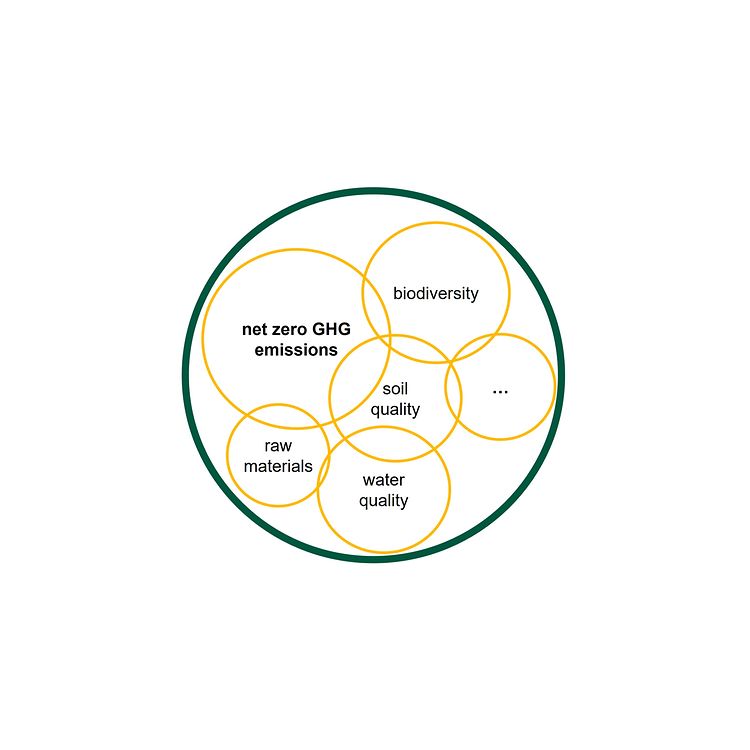
The principle of the circular economy aims to decouple economic growth from resource consumption. Because this consumption has far-reaching consequences. Not only are our natural resources limited and difficult to obtain, but currently 90 per cent of biodiversity loss is caused by the extraction and processing of resources. Added to that is the reduced energy demand when products and materials can be kept in their original state within the cycle for as long as possible. On our path to net-zero emissions, circular economy and climate management therefore go hand in hand.
A more circular economy offers companies the opportunity to increase their competitiveness, stimulate innovation, boost economic growth and, of course, create jobs. Several factors play into this. The use of secondary materials can lead to cost reductions. It also minimises risks in the supply of materials by reducing dependence on primary materials and disruptions in global supply chains. And last but not least, high-quality remanufactured products can reach new customer groups and thus lead to an increase in sales and profits.
Fulfilling Requirements
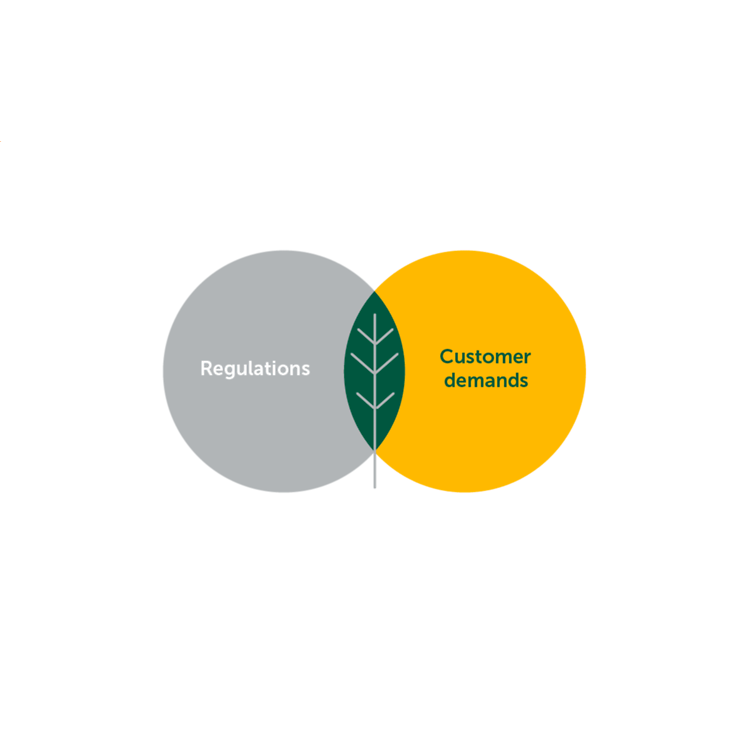
Fulfilling regulations and customer demands
The many new laws, regulations, and directives introduced in recent years present a challenge for companies. But not only that – they also drive progress and enable greater transparency and comparability. From the Circular Economy Act to REACH and RoHS, the Packaging Directive, the EU Taxonomy, the Battery and Ecodesign Regulations, and of course the new CSRD – there is a lot to consider, adapt, and track. This applies to us just as much as to our customers – whose expectations of us as a supplier are also rising as a result.
Jungheinrich has been working on many of these issues for many years. Corresponding measures can be found in our continuous sustainability reporting. In addition, the more recent regulations are incorporated into the development of our circular economy strategy and thus provide us with excellent guidelines.
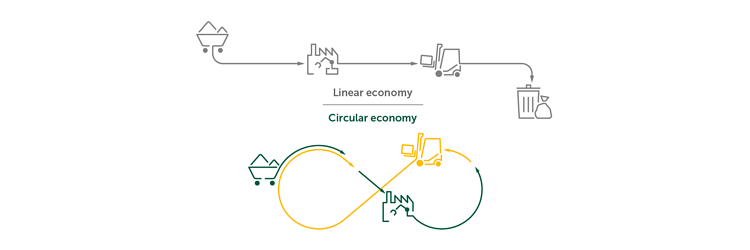
A circular economy is a system in which products and materials are kept in use for as long as possible in their most valuable state through repair, reuse, refurbishment, remanufacturing and recycling.
Its objective is to use resources as efficiently as possible, reduce waste, minimize environmental impact, and preserve the value of materials by keeping them in circulation throughout their entire lifecycle.
Important terms
Linear economy / Throwaway economy
The prevailing linear economy/throwaway economy contrasts with the circular economy. This model relies on large quantities of easily accessible materials and energy. Raw materials are extracted, processed, and turned into products. These are distributed, used, and disposed of.
Key points:
Predominant economic model
Opposite of the circular economy
Take-make-dispose structure
Sustainable development
Sustainable development and orientation are the fundamental prerequisites for transitioning our economy from a linear to a circular model. Sustainability means meeting the needs of the present in such a way that the ability of future generations to meet their own needs is not compromised. In this process, all three dimensions – ecological, economic, and social – should be considered equally.
Key points:
Intergenerational justice
Long-term perspective
Holistic approach
Resource use
Resource use is a major driver of other environmental impacts such as climate change, pollution, water and marine resources and biodiversity. A circular economy is a system that tends towards sustainable use of resources in extraction, processing, production, consumption and management of waste. Such system brings multiple environmental benefits, in particular, the reduction of material and energy consumption and emissions into the air (greenhouse gas emissions or other pollution), the limitation of water withdrawals and discharges and the regeneration of nature limiting the impact on biodiversity. (CSRD)
Key points:
Resource use along the value chain
Material and energy consumption
Environmental impact
Resource efficiency
Resource efficiency is defined as the relationship between a specific benefit or result and the deployment of resources required to achieve this. The aim of the efficient use of natural resources is to decouple economic growth from resource consumption. Product-related measures usually represent the most comprehensive approach to increasing resource efficiency. More efficient production processes, higher product quality, the use of sustainable energy, but also increased product utilization (e.g., through specific business models) lead to higher resource efficiency. (VDI)
Key points:
The relationship between benefits and the resources required
Decoupling economic growth from resource consumption
Product-related measures
(Product) Life Cycle
The product life cycle describes the entire life path of a product, process, or service. The focus is on raw material extraction, material processing, production, use, and recycling or disposal.
Key points:
Raw material extraction
Material processing
Production
Use
Product end-of-life
R-strategies
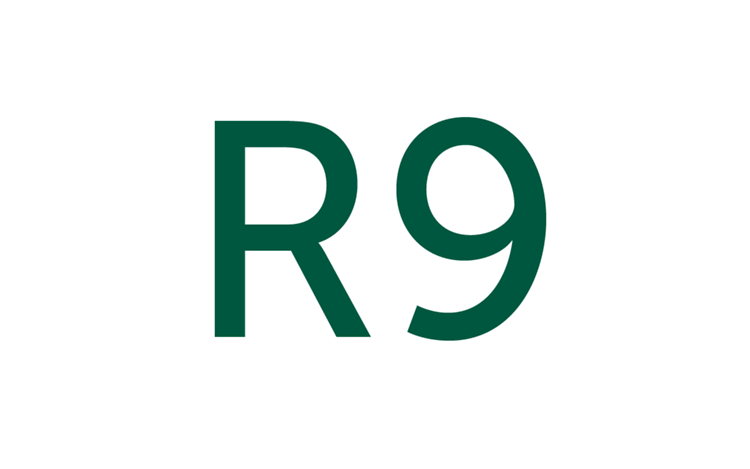
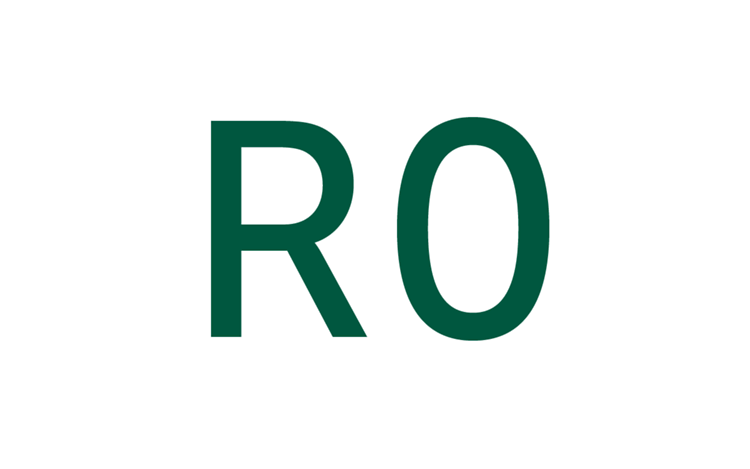
R-strategies describe action areas through which the value of a resource is maintained in its original state for as long as possible. The "R" stands for "Retention", meaning the preservation of the resource's value. In the case of finished products, the goal is to maintain the finished state and achieve reuse with minimal energy consumption, in order to extend the product's lifespan as much as possible. (vgl. Reike et al. [2018])
R-strategies are expressed through numbering and provide insights into the quality in terms of a circular economy (from high level/0 to low level/9) as well as the need for innovation (from high/0 to low/9).
Key points:
Reduce products or use them more efficiently and produce them more efficiently
The circularity rate is an average value that is calculated once at the end of the year. It is composed of the reuse rate and the recycled materials from our processed vehicles (including packaging).
Our lithium-ion batteries are not only given a second use in used trucks, but we also plan to offer battery refurbishment in addition to repair and reuse.
For us, environmentally responsible business means reducing the use of resources and systematically avoiding waste – for example through the refurbishment of products and the return of materials into the cycle.
With our circular economy strategy, we define concrete fields of action along the entire value chain, from material selection and product design to refurbishment and recycling.
We build on a wide range of measures that we are already successfully implementing today: our industrial trucks are refurbished in specialized plants, used batteries are tested for their remaining capacity and directed to second-life applications or recycling. At the same time, we continuously further develop our approach. This includes, among other things, the increased use of sustainable materials, the further development of our circular business models, and the continued improvement of reuse and recycling rates.
Our circular economy strategy is a central component of our Strategy 2030+ and systematically anchors circularity in our long-term transformation.