Active Load Management: Foppa charges its industrial truck fleet with 90 per cent self-generated solar power
Italian food wholesaler Foppa is maximising the use of its own photovoltaic system through intelligent energy management. With Active Load Management from Jungheinrich, the charging process of the industrial trucks is adjusted in real time to the available solar energy.
- Intelligent charging solution links industrial truck fleet with the company’s photovoltaic system
- Up to 90 per cent of charging energy from self-generated solar power – without stationary battery storage
- Dynamic adjustment of charging time and power to available solar energy reduces energy
Hamburg / Egna – Foppa has been operating a photovoltaic system at its headquarters in Egna, in the Italian province of Bolzano, since 2009. The system has been continuously expanded over the years and now has a capacity of around 1 MWp. This enables the family-owned company to generate a substantial share of its own electricity. The challenge was to make optimal use of the solar energy generated during the day for the industrial truck fleet.
“Our cold storage facilities and industrial trucks require high amounts of energy, especially in the evening and at night. At the same time, we generate a large amount of solar power during the day. The question was how to bring the two together in a sensible way in order to reduce costs and make better use of our self-generated electricity,” explains Renè Celva, Managing Director Purchasing and Logistics at Foppa.
Dynamic energy management instead of time-based charging
The solution is the Active Load Management (ALM) system of Jungheinrich. Unlike simple, time-based charging solutions, ALM is directly connected to the existing energy management system and controls the charging processes of the industrial trucks in real time. Both the charging time and the charging power are continuously adjusted to the currently available solar energy, the existing infrastructure and the applicable energy contract.
“Active Load Management ensures that the chargers are activated precisely when sufficient solar power is available. At the same time, the charging power is dynamically adapted to the existing infrastructure and the energy contract,” explains Sergio Bandirali, Solution Design Energy Systems at Jungheinrich Italy.
The “solar surplus charging” continuously synchronises energy generation and consumption, ensuring that as much solar power as possible flows into the industrial truck fleet at any given time. In this way, Foppa avoids unnecessary grid consumption while simultaneously relieving the existing infrastructure.
High energy consumption without additional storage technology
A key prerequisite for this flexible charging approach is the lithium-ion technology in use. “Unlike lead-acid batteries, lithium-ion batteries can also be charged at short notice and with variable power levels,” says Bandirali. “This is a major advantage when adapting the charging process to fluctuating solar power generation.”
The results are clear: “With Active Load Management, we have been able to increase the share of self-generated electricity used for charging our industrial trucks to around 90 per cent,” reports Celva. “At the same time, we have further reduced our energy costs – without the need for stationary battery storage.” This also makes Foppa less dependent on fluctuating electricity prices and increases planning reliability.
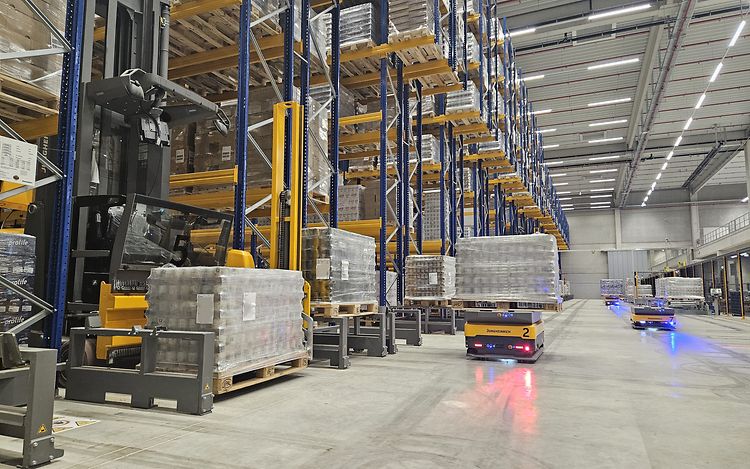
As part of the project, three existing vehicles were retrofitted. In addition, nine further order pickers with integrated ALM functionality were added. Therefore, twelve Jungheinrich ECE order pickers equipped with Active Load Management are currently in operation at the Egna site.
Operational benefits for warehouse operations
In addition to the energy and cost effects, the solution also offers practical operational advantages. With lithium-ion-powered vehicles, battery changes are no longer required, nor are separate charging rooms or the handling of heavy replacement batteries.
The concept implemented in Egna clearly demonstrates how photovoltaic systems can be optimally integrated into Material Handling operations through intelligent charging management. Further steps are already being planned, as the photovoltaic system generates more electricity than is currently required for charging the industrial trucks. “Together with Jungheinrich, we are looking at how we can use the surplus electricity for additional logistics-related processes in the future,” says Celva.