“Sustainability has to be measurable”: Helen Kappel on ratings, transparency and Jungheinrich’s role as a pioneer
Many companies claim to be sustainable. But how can this really be proven? Helen Kappel, Head of Sustainability Governance at Jungheinrich, explains why we rely on independent ratings.
The key insights
- Sustainability requires transparency: Jungheinrich makes its progress measurable by using independent ESG ratings to objectively assess and further develop its own performance.
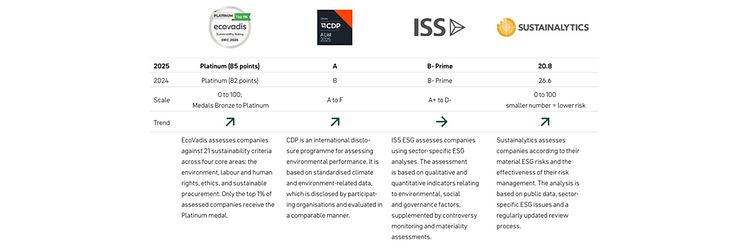
- Ratings offer different perspectives: Assessment platforms such as CDP, EcoVadis, ISS ESG and Sustainalytics consider various aspects of sustainable business practices – from climate protection and supply chains to ESG risks.
- High ratings as an incentive for the future: With top results such as EcoVadis Platinum and the CDP’s ‘A’ rating, Jungheinrich demonstrates its strong sustainability performance – and is continuously working on further improvements.
Sustainability thrives on transparency: only those who clearly measure progress can demonstrate their successes and work on targeted improvements. That is why Jungheinrich focuses on independent ESG ratings that evaluate its sustainability performance from various perspectives. In this interview, Helen Kappel, Head of Sustainability Governance at Jungheinrich, talks about the importance of these ratings, the latest results and why high ratings are an incentive for further improvements.
Helen, when we talk about sustainability: how can we actually assess just how sustainable a company really is?
Sustainability can only be assessed credibly if it is measurable. That is why we disclose our data and progress transparently – for example, in our Sustainability Statement and the ESG Factbook – and also have our performance regularly assessed by independent rating agencies. ESG ratings from leading organisations such as CDP, EcoVadis, ISS ESG and Sustainalytics provide us with an objective assessment and show us where we stand today and where we can continue to improve. These external assessments are not only an important yardstick for our own sustainability performance, but also a benchmark against our competitors. Furthermore, they create transparency for our stakeholders, such as customers and investors.
Why does Jungheinrich take part in so many different ratings?
We deliberately rely on various ratings because they examine sustainability from different perspectives. CDP, for example, focuses explicitly on environmental performance, whilst EcoVadis takes a broader approach and also assesses how we manage issues such as working conditions, ethics and supply chains. Other ratings, such as ISS ESG or Sustainalytics, place greater emphasis on industry comparisons or on how resilient our business model is to ESG risks. Taken together, these perspectives provide a nuanced picture and help us to manage our sustainability performance holistically.
How does Jungheinrich currently fare in these assessments?
We are on the right track. The rankings prove that we are already among the leading companies in key areas. In 2025, we were once again awarded Platinum status by EcoVadis – for the fifth year running. According to EcoVadis, this means we continue to rank among the top one per cent of assessed companies worldwide. Particularly against the backdrop of rising standards, this is a clear signal of the quality and consistency of our sustainability work. Our CDP result also underlines this commitment. We are consistently implementing our climate strategy and, thanks to this progress, received the top ‘A’ rating in 2025. At CDP, ‘A’ stands for ‘Leadership’ and thus for companies that play a pioneering role in climate protection, effectively reduce emissions and can demonstrate this transparently.
Do you see such awards as confirmation or motivation?
Both. Naturally, we’re delighted with excellent ratings. They show that our approach is on the right track and that we’re already operating at a very high standard in many areas. At the same time, we deliberately view ratings as a management tool. They help us to assess our performance in the market, set priorities and further develop our sustainability strategy in a targeted manner. It is particularly when comparing ourselves with other companies that it becomes clear where we are already playing a leading role and where we still have room for improvement.
Finally: How would you summarise the current state of your sustainability work?
Sustainability is not a goal that we simply achieve and then tick off our list. It is an ongoing process of transformation. We are on the right track and are already very well positioned in key areas such as climate protection. At the same time, we are constantly working to further improve our performance and to make our ambitious goals even more consistently measurable and manageable.
For us, however, it is not so much the status quo that matters as the impact: we want to develop sustainable solutions that make a difference and, in doing so, play an active role in the transformation of our industry.