Award-winning AI: How intelligent software is already transforming spare parts logistics
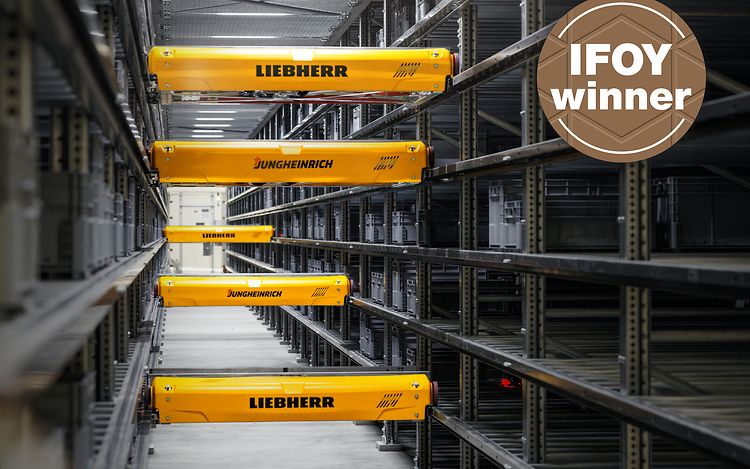
Our AI solution for the Liebherr Group, which won the IFOY Award 2026, demonstrates the added value that intelligent software is already delivering in day-to-day operations. An interview with Matthias Schneebauer and Immanuel Mark.
Key takeaways
AI is already making operational decisions autonomously in warehouse operations.
Our IFOY-award-winning Jungheinrich solution demonstrates how intelligent software and data are becoming a key success factor in modern material handling.
The greatest added value is achieved when technology is consistently tailored to the customer’s requirements and processes.
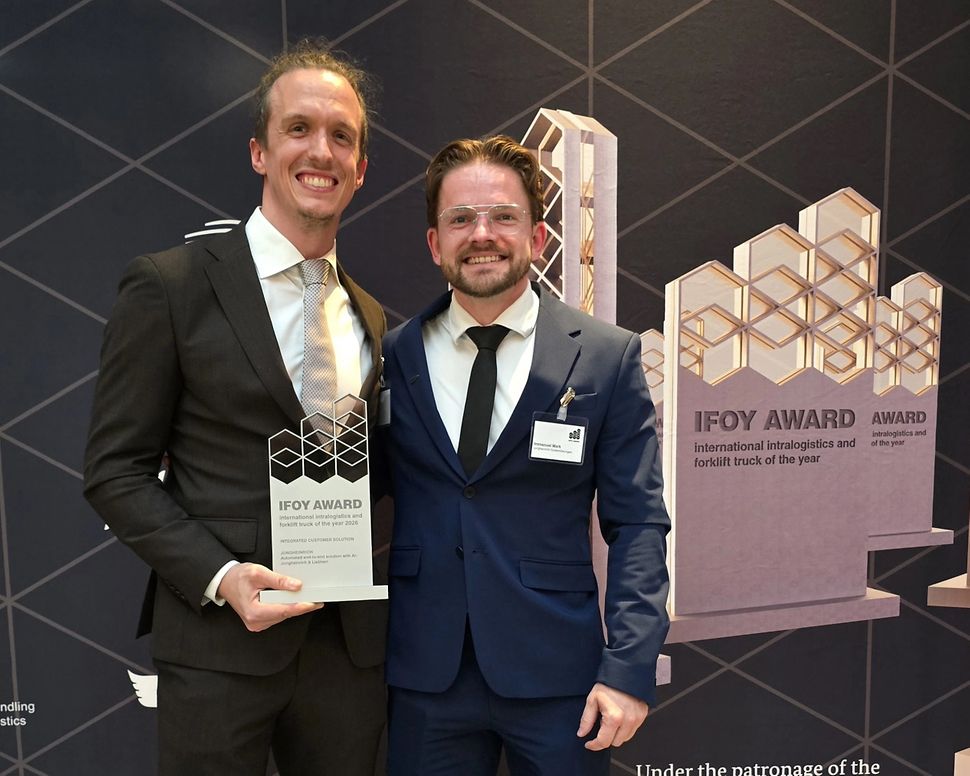
With an AI-supported solution for the Liebherr Group, we at Jungheinrich have demonstrated how complex warehouse processes can be intelligently controlled in real time. At the heart of the solution is an intelligent extension of the Jungheinrich Warehouse Management System (WMS), which analyses warehouse processes in real time and supports operational decision-making. For this, we received the IFOY Award 2026 in the “Integrated Customer Solution” category. Matthias Schneebauer, Director Product Warehouse Control & Management Software, and Immanuel Mark, Head of Project Implementation WMS, provide insights into the project and explain how artificial intelligence is already transforming day-to-day warehouse operations.
Immanuel, Liebherr manages around 90,000 different spare parts at its site in Ehingen near Ulm and operates round the clock. What was the biggest challenge for Jungheinrich in implementing the new warehouse?

Immanuel: One of the biggest challenges was to harmonise the multitude of different material flows and standardise warehouse processes. At the same time, it was essential to map the complexity of operations in such a way that meaningful and sustainable solutions could be developed. Close communication with the customer was therefore a crucial factor for success throughout the entire project.
Matthias, what specific tasks does the AI perform in this award-winning solution?
Matthias: The AI helps the customer to better understand their warehouse and manage it more intelligently. It continuously learns from operational data and decisions already made, enabling it to optimise the material flow on an ongoing basis.
Furthermore, it automates complex decisions, such as prioritising orders based on current stock data and precisely forecast lead times.
The solution therefore goes far beyond traditional automation. What do you think makes it special?
Immanuel: What makes our solution special is that it is already successfully integrating artificial intelligence into day-to-day warehouse operations. Whilst many are still discussing potential use cases, our AI is already delivering tangible added value every day in live operations.
This is made possible because the actual intelligence lies not in the visible components of the automation, but in the software. It analyses data in real time, supports complex decision-making and ensures that processes run more efficiently and that staff are noticeably relieved of some of their workload. This gives us a clear edge in the market.
Looking back, what are you particularly proud of?
How long did you work on the solution?
Immanuel: The foundations of our AI logic date back to 2019. The specific Liebherr project began in 2020 and was subsequently developed continuously over several years in collaboration with the client. The award-winning solution is therefore the result of many years of product development, intensive project work and a close partnership with Liebherr.
What does it mean to you that your work has now been recognised with an IFOY Award?
Matthias: It means a great deal to us. On the one hand, it confirms that we are developing our product strategically in the right direction. On the other hand, it recognises the close collaboration across many teams.
The real success, however, is that our solution is in use every day, improving warehouse operations and making people’s work easier. That is precisely what we expect from innovation.