Lower costs, lower risk, lower CO₂e: the key lies in the value chain
Those who use materials and energy more efficiently can not only reduce costs and risks, but also avoid emissions. Here at Jungheinrich, we demonstrate why the greatest potential lies along the value chain – and how this creates business opportunities.
The key insights
- Reducing costs also reduces CO₂e. Materials and energy are the biggest cost drivers and, at the same time, the biggest sources of emissions.
- The greatest leverage does not lie within our own factory. At Jungheinrich, for example, around 98 per cent of greenhouse gas emissions arise within the value chain, primarily from purchased materials and the use of our products.
- Three steps make all the difference. Jungheinrich involves partners, takes action where it yields the greatest economic benefit, and rethinks products right from the start.
- Efficiency sells. Customers are increasingly focusing on total costs over the product’s lifetime and on reliable data.
What do cost reduction and decarbonisation have in common?
Both address the same areas: materials, energy and the supply chain.
Many of the factors driving up the cost of materials and energy are directly linked to CO₂e. The EU Emissions Trading Scheme is making energy-intensive materials such as steel more expensive, and CO₂e prices are set to rise further by 2030 (IEA, OECD). Added to this is the Carbon Border Adjustment Mechanism (CBAM), which imposes surcharges on CO₂e-intensive imports such as steel (Fastmarkets).
Raw materials are also becoming scarcer: according to the International Energy Agency, there is a risk of a supply shortfall of around 30 per cent for copper by 2035, as demand is growing faster than supply due to electrification (IEA Critical Minerals Outlook 2025). Suppliers are increasingly passing on CO₂e-related surcharges.
Commodity markets and geopolitics cannot be controlled by companies, but they can manage their own vulnerability to them. Three strategies can help counter this cost pressure whilst simultaneously reducing emissions:
- Use fewer primary materials: Reducing material usage, utilising recycled materials and reprocessing lower the demand for expensive primary raw materials.
- Limiting cost risks: Companies that opt for lower-emission materials and processes are less affected by rising CO₂e prices and border adjustment levies.
- Securing supply chains: Companies that have a detailed understanding of their materials and suppliers can identify dependencies and bottlenecks at an earlier stage. At the same time, this reveals where the majority of emissions originate and where switching to lower-emission suppliers or materials yields the greatest benefits.
How does Jungheinrich go about this?
At Jungheinrich, around 98 per cent of greenhouse gas emissions occur along the value chain, from purchased materials and transport right through to the use of the products by customers. Take our forklift truck as an example: a large proportion of its emissions occurs even before assembly – for instance, during steel production – whilst another proportion is generated over many years of use.
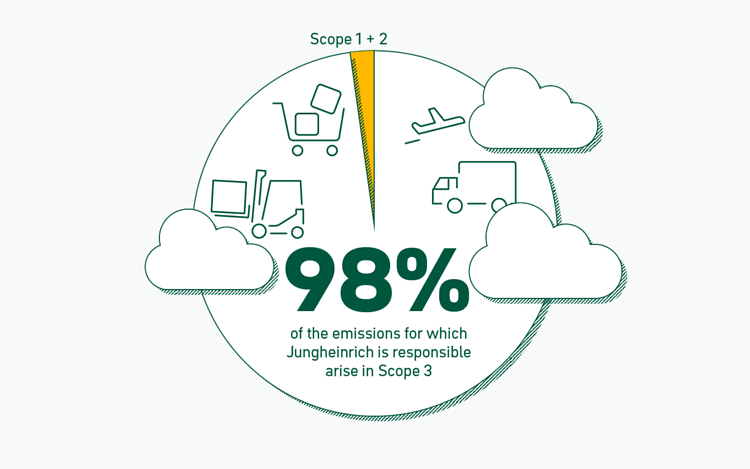
At Jungheinrich, we are following a roadmap comprising three interlinked steps to achieve this. In the long term, our goal is to achieve net-zero greenhouse gas emissions by 2050, in line with the Science Based Targets initiative (SBTi).
1. Engaging partners: raising awareness and creating transparency
Good decisions require good data. In complex supply chains, this data is often lacking, leaving us with no choice but to rely on average figures. That is why we are raising awareness amongst suppliers and customers and empowering them to determine and provide their own emissions data, and to reduce emissions themselves. This reveals where measures will have the greatest impact.
2. Taking targeted action: focusing on where it delivers the greatest economic benefit
We prioritise measures according to their economic and environmental impact. Take steel, for example: the amount of CO₂e it generates depends on the proportion of recycled scrap and the production process. We use both of these as levers in our procurement. Another example is remanufacturing: it extends the service life of industrial trucks. Up to 99 per cent of the raw materials can be reused or recycled, and emissions are reduced by up to 80 per cent CO₂e compared with a new vehicle.
3. Rethinking: avoiding costs and emissions from the outset
The cheapest costs and emissions are those that are not generated in the first place. That is why Jungheinrich takes material selection, energy efficiency, durability and recyclability into account right from the early stages of product development.

“The greatest opportunities arise where sustainability and innovation converge. Decarbonisation helps us to make supply chains more resilient, manage costs more effectively in the long term and, at the same time, develop new solutions for the material handling of tomorrow.”
Maik Manthey, Member of the Board of Management, Technics, Jungheinrich AG
Why are efficient products becoming a selling point?
Because customers are increasingly looking at the total cost over the product’s lifetime, rather than just the purchase price.
Energy consumption, service life and reconditioning determine what an industrial truck costs over the years. An energy-efficient vehicle reduces energy costs during operation and thus also emissions. At the same time, customers are increasingly asking for reliable data, such as the Product Carbon Footprint (PCF) – that is, a product’s emissions over its life cycle – or information on their suppliers’ climate targets. Those who can provide this data make the purchasing decision easier.
“Our customers are looking for efficient, circular and safe solutions, as well as reliable data. This is precisely where our opportunity lies: by translating sustainability into tangible customer benefits, we build trust and open up new business opportunities.”
Nadine Despineux, Member of the Board of Management, Sales, Jungheinrich AG
Conclusion: Think economically, reduce emissions
Keeping track of costs, risks and customer requirements throughout the entire value chain also helps to reduce emissions. The greatest progress is made when companies work together with suppliers and customers. Jungheinrich makes this connection an integral part of the further development of its products, processes and business models, for cost-effective and sustainable material handling.
Click here to find out more about sustainability at Jungheinrich.
Frequently asked questions about decarbonisation