From an internship to a Ph.D.: How Philipp is researching the vehicle acoustics of tomorrow with Jungheinrich
Philipp Priller has been working with Jungheinrich since his internship. In this interview, he talks about his career path, his work with Jungheinrich, and the experiences that have had a particularly profound impact on him.
The key insights
- A continuous career path: From an internship to theses to a Ph.D., Philipp and Jungheinrich have maintained a long-standing research partnership.
- Practical research: The focus is on innovative acoustic and simulation methods for the next generation of electric industrial trucks.
- Results you can hear: Findings from his research helped shape, among other things, the acoustic and vibration design of the new EFG 2/2i and 3/3i series, which set new standards at just 63 dB(A).
How do innovations come about? Often where science and practice work closely together. This is precisely the path Philipp Priller has taken. What began with an internship in the Simulation department at Jungheinrich evolved into a long-term collaboration through his bachelor’s thesis, research-based master’s program, and work-study position. Today, he is pursuing his doctorate at OTH Regensburg in the field of vehicle acoustics—with Jungheinrich as his industry partner.
In this interview, Philipp explains why the combination of research and practical experience inspires him, what role Jungheinrich plays in his career path, and why students benefit greatly from industry partnerships.
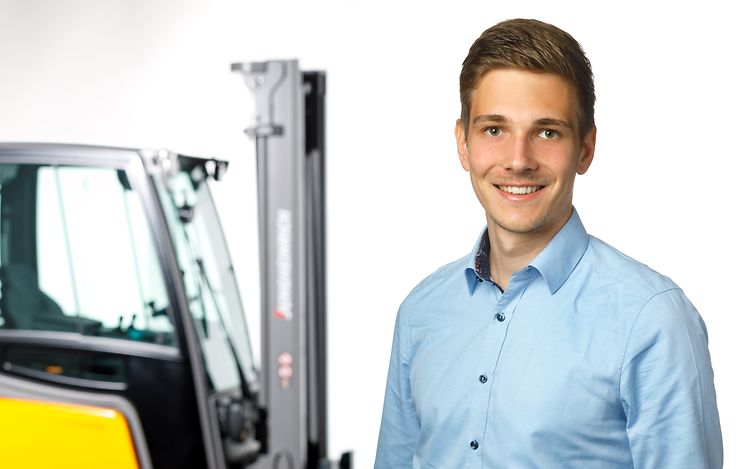
Philipp, your collaboration with Jungheinrich began while you were still in your studies. How did that lead to your current career path?
My first contact with the company came through an internship in the Simulation department in Moosburg. Afterward, I was given the opportunity to write my bachelor’s thesis there, focusing on the simulation-based optimization of the driver’s cab of an electric forklift. The goal was to reduce vibrations and improve ride comfort and acoustics.
After completing my bachelor’s degree, I continued my studies in mechanical engineering in the research-oriented master’s program at OTH Regensburg. Together with Jungheinrich, I was able to further deepen my work in the field of vehicle acoustics, gain practical experience as a working student at the same time, and ultimately write my master’s thesis on acoustic measurement and simulation methods. Today, I work as a research assistant at OTH Regensburg and am pursuing my Ph.D. in the same field of research.
What makes the collaboration between the university and Jungheinrich so special to you?
For me, it’s above all the combination of scientific research and real-world challenges from industry. Many of the questions I’m working on have a direct connection to practical applications. This allows me to see immediately how my work can be beneficial.
At the same time, I’ve experienced at Jungheinrich that young engineers are given a great deal of trust. You take on responsibility early on, but you always receive professional support. This combination has helped me grow both professionally and personally.
What are you currently working on as part of your doctoral research?
My research focuses on the acoustics of electric drive systems. I’m investigating how structure-borne noise is generated and how acoustic properties can be reliably evaluated even in early development phases. The goal is to make vehicle development even more targeted and to ensure acoustic requirements are met early on.
Jungheinrich is an important industry partner in this effort. The collaboration provides real-world research questions and enables scientific findings to be directly incorporated into development.
Was there a moment you’re particularly proud of?
A real highlight for me was the launch of the new EFG 2/2i and 3/3i series. The comprehensively revised acoustics and vibration concept helps these vehicles set new standards with a noise level of just 63 dB(A). Knowing that my research was able to make a small contribution to this is a great feeling.
What advice would you give to students considering a collaboration with a company?
I would recommend that everyone gain practical experience as early as possible. During your studies, you learn the theoretical foundations—but you only discover how to apply them in practice through real-world projects. Industry collaborations help you discover your own interests, grow professionally, and build valuable contacts for your future career path. For me, it was precisely this combination of science and practice that was the decisive step.