From Moosburg to Texas: How international experience has changed Ludwig Herzog’s day-to-day work
What happens when your own way of communicating and working encounters a completely new environment? During his two-year assignment in Houston, Ludwig Herzog learnt how cultural differences shape collaboration – and why this, in fact, presents a great opportunity.
Key insights
Openness builds trust. Positive and engaging communication can make collaboration noticeably easier.
Different ways of working present a learning opportunity. Those who are open to discovering other perspectives broaden their own view of tasks and solutions.
Clarity creates certainty. The more varied communication styles are, the more important it is to align expectations and avoid misunderstandings.
International collaboration is an integral part of everyday working life at Jungheinrich – in projects, teams and when working abroad. It brings together different locations and perspectives, thereby laying the foundations for innovation and further development. At the same time, different expectations and ways of working come into play – and this is precisely where misunderstandings can arise. Often, the reasons are not a lack of expertise, but rather different cultural backgrounds or communication styles.
This is what intercultural competence is all about: it means recognising differences, putting them into context and dealing with them constructively. What matters most is less theory and more actual behavior – such as active listening, questioning one’s own assumptions and engaging with different perspectives in an open and respectful manner. Intercultural competence is therefore a key success factor for the future viability of a truly global company like Jungheinrich. Once we view cultural backgrounds and ways of working as resources, we can strengthen collaboration, deal constructively with tensions, and develop better solutions together – across national and organizational boundaries.
Working abroad, in particular, offers a valuable opportunity to develop intercultural competence practically: It fosters direct exchange, creates a deeper understanding of different ways of working, and provides a firsthand experience of diversity in everyday life.
Ludwig Herzog discovered just how formative these experiences can be during his two-year assignment in Houston, Texas. After seven years at the Moosburg site, he moved to the USA at the end of 2023 to work on a project. There, he supported a project related to Rocrich, the joint venture between Jungheinrich and Logisnext Americas, and took on responsibility for setting up a product support process for the North American AGV market.
Two years in Houston – working amid highways, heat and high tech
Ludwig, why Houston – and what was your role?
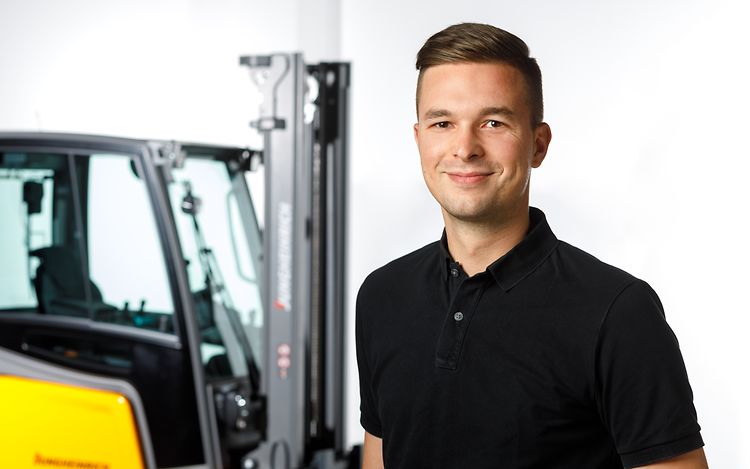
Ludwig Herzog: After seven years at the Moosburg site, it was a great opportunity for me to do something completely new again. By sending me on this overseas assignment to Houston, Jungheinrich gave me the chance to develop both professionally and personally, and to take on responsibility in an international environment.
It all began shortly before the turn of the year in 2023: intensive preparation, lots of new topics – and finally, the start of a completely different working environment in Texas. There, a forward-looking project awaited me within Rocrich, the joint venture between Jungheinrich and Logisnext Americas: setting up a product support process and a technical helpline for the North American AGV market.
As well as the technical topics, however, our day-to-day interactions were also an important experience for me. Although we were all working towards similar goals, we sometimes took very different approaches to our tasks and to communication.
What surprised you about everyday life in the USA?
Above all, the friendliness struck me right away. Communication is very much a part of everyday life – even in situations where I might not have expected it at all back in Germany.
For example, I was surprised at how commonplace positive and spontaneous comments from complete strangers are in everyday life – such as at the supermarket checkout or when interacting with service staff. At first, this might seem like a minor thing, but it changes the atmosphere in our interactions.
I’ve also experienced this in my day-to-day working life. A positive attitude and a willingness to approach one another openly make it easier to strike up a conversation and build trust.
For me, this was an important realisation: friendliness and mutual respect aren’t just a matter of personal interaction. They can also play a very practical role in making collaboration easier and more constructive.
What have you learnt from working with different approaches?
I tend to be more structured and planning-oriented myself. In my working environment in the USA, however, I have at times encountered a significantly more flexible approach.
At first, this felt unfamiliar to me. Over time, though, I realised just how helpful this flexibility can be – particularly when circumstances change rapidly or pragmatic solutions are required.
At the same time, I have learnt that different communication styles can also lead to misunderstandings.
At first, I sometimes interpreted statements such as “Sounds good” or “We’ll take care of it” as more binding than was actually intended. To me, such a statement initially amounted to a firm commitment. Over time, I’ve learnt to listen more carefully and to double-check on important points.
That may sound like a minor change. In fact, however, it has had a lasting impact on the way I communicate.
What are you doing differently today compared to before your assignment in Houston?
I’m now more mindful of how I communicate and collaborate. I check in more often, actively clarify expectations and rely less on implicit assumptions.
In my view, it’s particularly important in international teams not to assume that everyone understands the same things by certain terms or statements. What is clear to one person may mean something completely different to another.
At the same time, I’ve learnt not to judge different ways of working straight away. My initial reaction to a very flexible approach used to be, at times: ‘Why aren’t we planning this in more detail?’ Nowadays, I’m more likely to ask myself: ‘What can we learn from this approach?’
That has changed my own perspective on collaboration.
Why do you think international experience is so valuable?
International assignments bring together knowledge, experiences and perspectives across national borders. They foster a better understanding of different markets, customer requirements and ways of working.
For me personally, however, the most valuable aspect was the experience of viewing my own way of working from a different perspective. When you spend a longer period of time in a different environment, you realise that many things you take for granted aren’t actually a given.
For me, that’s precisely where the greatest value of cultural diversity lies: not everyone has to work or think the same way. On the contrary. Different perspectives can help us ask better questions, find new solutions and further develop our own outlook.
If your personal circumstances allow, I can therefore only recommend seizing the opportunity to live and work abroad. It is an experience that makes a huge difference professionally – and just as much, if not more, on a personal level.