"Data is the key to enhanced customer value" – Lydia Schneider about smart products and digital innovations
Whether in service optimisation, energy efficiency or vehicle development, data opens up completely new possibilities. Lydia Schneider, Portfolio Management Digital Products and Solutions, explains how we at Jungheinrich use this data to create solutions with real added value.
What happens when decades of experience in intralogistics meet digital intelligence? At Jungheinrich, this results in solutions that go far beyond vehicle and system technology. In this interview, Lydia Schneider, Portfolio Management Digital Products and Solutions, reveals how data opens up new perspectives – and why it is the key to real customer benefits.
Lydia, you work in the Digital Products & Solutions division at Jungheinrich. What exactly does that mean?
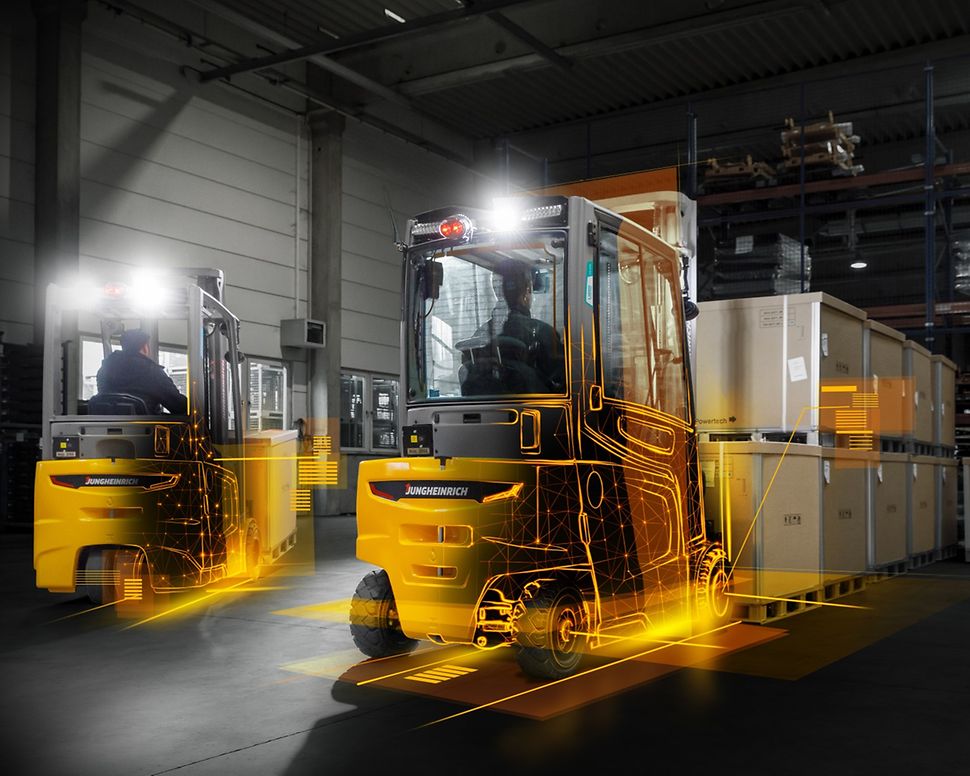
We drive the development of digital products and services based on usage data – in other words, the information that our networked products collect during use. We aim to transform this data into solutions that simplify tasks and improve efficiency for our customers. This ranges from data-based consulting and service optimisation to completely new, smart products.
How do customers benefit from this data in concrete terms?
For example, through fact-based consulting. We analyse how intensively individual vehicles or entire fleets are used and can derive concrete recommendations from this. For example, we identify solutions to optimise the customer’s fleet and warehouse, or assess whether it might be more economical to switch the service model, such as from standard maintenance to tailored service concepts. This helps our customers to become more efficient and reduce costs.
And what about service?
Here, too, data makes many things easier. We use it to identify problems more quickly and respond in a more targeted manner. Among other things, we rely on remote services, which already enable us to identify the causes of problems remotely and, in the future, even solve problems before they occur. Our decades of experience in service and proven best practices help us to do this. For our customers, this means less downtime and more uptime.

Can you give a specific example of a product that you have developed based on data?
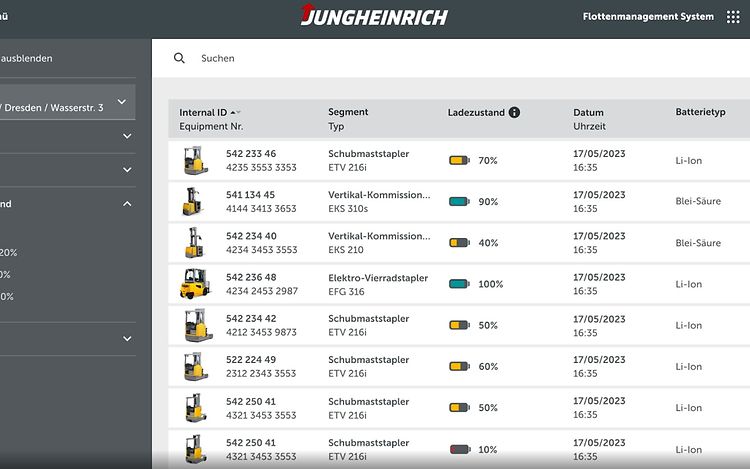
A good example is the battery monitoring system we have developed. This allows our customers to see the charge status of all vehicle batteries at any time – in real time and at a glance. This enables them to react early on before a vehicle is in danger of running low on charge or if a battery has been charged incorrectly. In the future, we want to further expand our Smart Energy Solutions and enable our customers to use energy even more efficiently and based on their specific success metrics.
And what does the future look like?
By analysing vehicle data, we are learning more and more about how our products are used in everyday life. These insights flow directly into the development of new functions – for example, for greater safety, ergonomics and efficiency. One example: in one of our latest development projects, we incorporated usage data from over 14,000 customer deployments. Based on this data, we realised that in most applications, our customers do not utilise the full battery capacity in their vehicles. So we launched a new vehicle with a smaller battery compartment and thus a lower entry height. This significantly improves ergonomics for drivers.
In addition, we gain valuable insights into entire warehouse processes. By combining data, vehicles and systems, we can optimise our customers' intralogistics in a targeted and holistic manner. In this way, we are evolving from a pure manufacturer to a true partner – with solutions that make our customers more successful in the long term.