FalcOn: How we brought high-voltage technology to the heavy-duty sector
Can electric mobility also prove its worth in the heavy-duty sector? Our FalcOn demonstrates how electric drives are opening up new performance horizons in material handling.
Heavy loads, long operating hours and high performance requirements: in many demanding applications, combustion engines are still considered the first choice. At the same time, the question arises as to what extent modern electric mobility can already cover these areas of application today.
With our FalcOn development project, we have provided an answer to this. Within eight months, we created a drivable high-voltage heavy-duty forklift that demonstrates the potential electric drive technology can already unleash in demanding operating profiles today.
Why we have reimagined heavy-duty forklifts
The electrification of material handling has been advancing for years. In many sectors, electric vehicles have already established themselves as a more efficient and cost-effective solution compared to combustion engines. However, particularly demanding applications – such as in the beverage industry, building materials logistics or other heavy-duty applications – are still frequently dominated by vehicles with combustion engines.
The demands are high: heavy loads, intensive multi-shift operations, long operating hours and often challenging environmental conditions. This is precisely where we wanted to start.
“With the FalcOn, we want to demonstrate that electric forklifts can be a genuine alternative to combustion engines even in the toughest operating conditions,” says Andreas Schiller, Global Portfolio Lead for Counterbalance Heavy Trucks.
For us, the focus was not solely on developing a high-performance vehicle. Rather, we wanted to understand how modern high-voltage technology can be used to combine productivity, availability and sustainability.
From concept to roadworthy vehicle in just a few months
From the outset, FalcOn was designed as a focused development project. Instead of large-scale project structures, we relied on a small, interdisciplinary team, short decision-making processes and a clear focus on the key technical issues.
The result: just around four months after the project started, a roadworthy vehicle was available for initial testing. After a total of eight months, commissioning was largely complete and the optimisation phase had begun.
In parallel, the teams worked continuously on software development, system integration and testing. For us, the project impressively demonstrates just how much speed is possible when technical expertise, clear goals and agile collaboration come together.
Why the overall system is crucial
A key insight from the project is that performance is not derived from individual components, but from their interaction.
That is why FalcOn was developed from the outset as an integrated overall system. At its heart is a high-voltage architecture that optimally integrates the battery, power electronics, drive system and thermal management.
All key components are actively water-cooled. This ensures that performance remains consistently available even under high sustained loads – a crucial factor for demanding heavy-duty applications.
“It is not just the voltage level that matters, but the interaction of all components,” explains Dr Jasper Schnack, project manager for the development of the FalcOn.
It is precisely this systems-based approach that we see as a key technological lever for taking electric drives into new performance realms.
Performance developed for real-world use
FalcOn is not a technology demonstrator for the laboratory. The vehicle was developed with a consistent focus on real-world operating conditions.
With a load capacity of up to 6,000 kilograms and a load centre of gravity of 600 millimetres, it is designed for high handling capacity and addresses typical requirements in the heavy-duty sector.
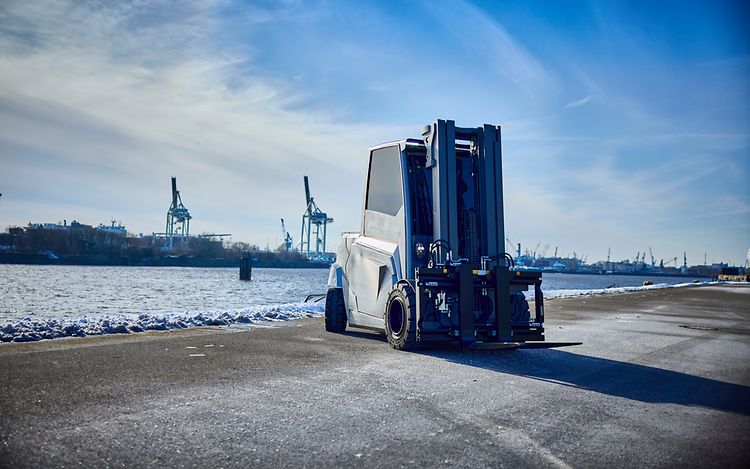
Combined with a high driving speed of up to 26 km/h and dynamic acceleration, the vehicle demonstrates the productivity potential that electric drives can offer. The FalcOn also sets new standards when it comes to lifting: with a lifting speed of 0.6 m/s under load, it enables particularly efficient operations in high-frequency handling processes.
Another key factor is its fast-charging capability. Via a CCS-2 interface, the vehicle can be charged from around 20 to 80 per cent in approximately 30 minutes – a clear advantage for applications with short downtime.
For users, this means one thing above all: high handling capacity combined with short charging times and high vehicle availability. These factors can be decisive, particularly in multi-shift operations.
Designed for everyday use
Innovation only truly proves its worth when it performs reliably in day-to-day operations. That is why FalcOn has been specifically designed for real-world operating conditions – both indoors and outdoors, at high cycle rates and in demanding environmental conditions.
The insights gained from the project demonstrate the potential that high-voltage technologies can offer for the further electrification of heavy industrial trucks in the future.
Technology in focus, design with impact
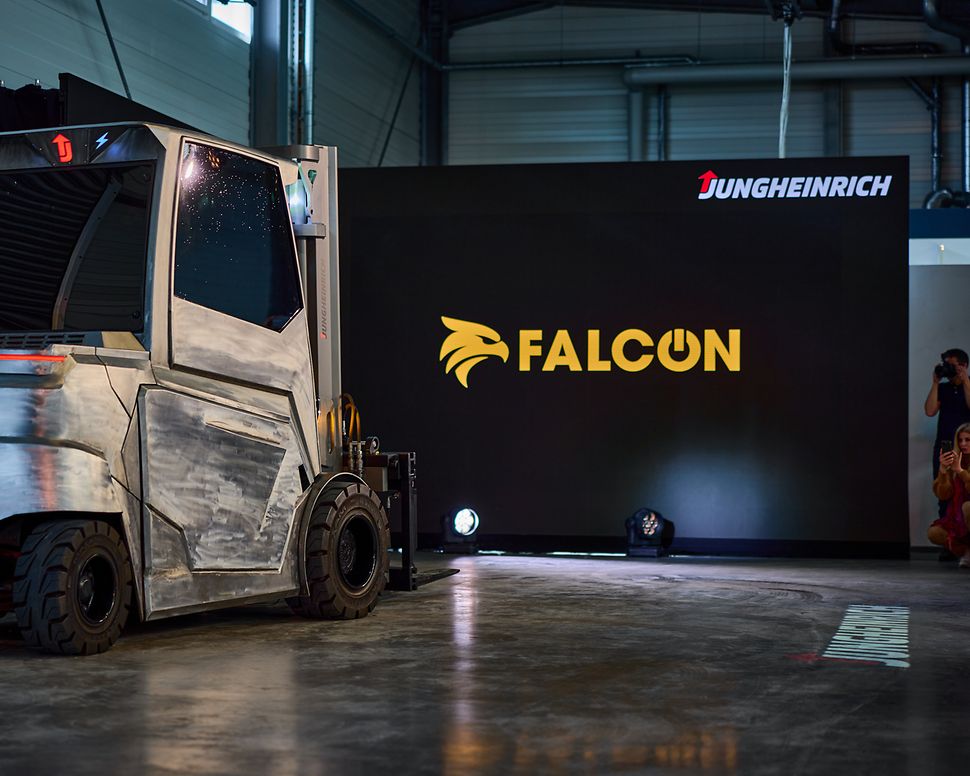
Purist, visionary and innovative – the stainless steel look of the new FalcOn is deliberately more than just a visual statement. From the outset, the focus was on the persuasive power of the technology, not merely the design. The striking, minimalist design language is the result of close collaboration between development and prototyping – a joint decision that underlines the commitment to functionality and future-proofing.
The result: a vehicle that confidently conveys its technical strength visually as well. Or as Dr Jasper Schnack aptly puts it: “It just looks incredibly powerful.”
The eye-catching stainless steel look was deliberately chosen for the trade fair presentation – a striking appearance for the showcase. In series production, however, the FalcOn returns to the characteristic Jungheinrich yellow, remaining clear and recognisable.
The name FalcOn is inspired by the falcon – a bird that embodies precision, power and speed – and will later be introduced to the market as the EFG Series 6.
Looking ahead
For us, the FalcOn is more than just a single development project. The vehicle exemplifies how new technologies can be tested, evaluated and further developed more quickly.
Above all, however, the project demonstrates that electric drive concepts can already achieve performance levels today that were long considered the domain of conventional combustion engines.
The electrification of material handling does not stop at light or medium-duty applications. With FalcOn, we have taken a further step towards electric heavy-duty applications – and gained valuable insights that will be incorporated into future technologies and product generations.