Zero-Harm in practice: How our plants are championing occupational safety
Current figures show that our occupational safety measures are working. We explain why awareness is crucial in this regard and use three plants as examples to show how safety is actively promoted in day-to-day operations.
At Jungheinrich, we pursue a clear goal across the Group with our Zero-Harm strategy: to prevent workplace accidents and continuously improve safety and health in the workplace. Whether we are actually making progress can be measured, for example, using the Lost Time Injury Rate (LTIR). This figure shows how often workplace accidents occur that result in at least one day’s lost time (excluding commuting accidents). This frequency is calculated per million hours worked.
The trend speaks for itself: in 2019, the Group-wide LTIR was still 16.8. It has since fallen to 10.5. For us, this is clear evidence that our measures are working and that we are improving step by step.
Fewer accidents through awareness, mindset and behaviour
Around 95 per cent of all accidents are behaviour-related. In theory, accidents can be most effectively prevented through a combination of awareness, mindset and behaviour: When employees know what to look out for (awareness or safety awareness) and internalise this (mindset), the likelihood of safe behaviour increases. This can also be observed in our plants, meaning that continuous awareness-raising measures are paying off for them.
Three examples: Occupational safety in practice
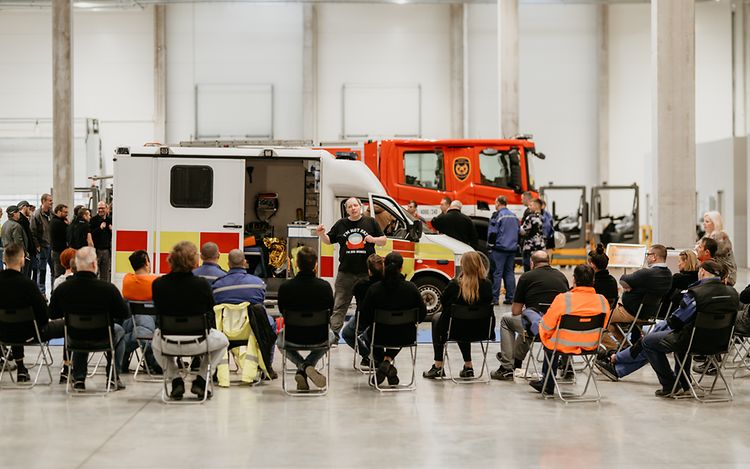
Chomutov: Safety from the outset and on a regular basis
In Chomutov, safety culture was factored in right from the start when the site was being established, and a dedicated training room was set up. Internal training sessions are held there regularly, during which employees can practise, for example, carrying out complex assembly tasks, repairing any form of leakage, and using the correct protective equipment.
In 2023, Safety Days were introduced in Chomutov – the first Jungheinrich site to do so – to build a sustainable safety culture. Since then, these event days have taken place once a year. The focus of the last Safety Day in October 2025 was on a range of practical exercises: first aid, waste separation, reporting near-misses, fire-fighting drills with the fire brigade, safe reach truck operation, ergonomic exercises and the simulation of a car accident.
Thanks to the Chomutov team’s approach of sharing practical experiences, learning from one another and constantly raising awareness of safety in everyday life, accidents can be significantly reduced: the site remained accident-free for over a year after production began.
Dresden: Safety Day as a hands-on impetus for safe routines
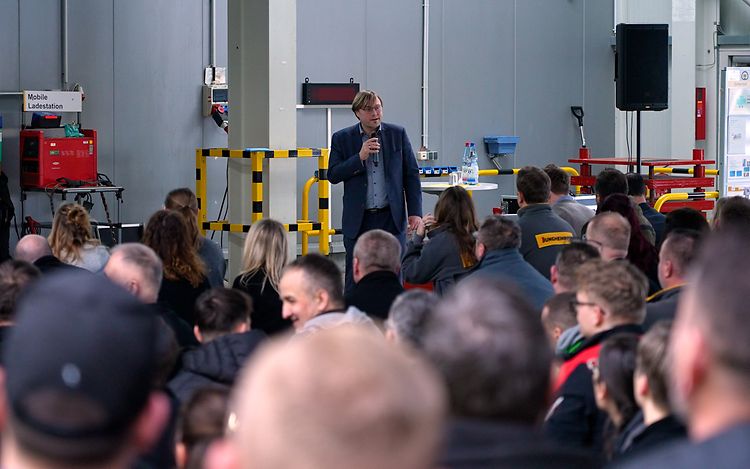
Just how effective safety measures can be is also evident in Dresden. The team relies on new formats to actively engage employees. Safety inspections, training sessions and action days raise awareness of potential risks among the entire workforce.
The first Safety Day in Dresden took place in February. This makes Dresden the second plant site, after Chomutov, to have held this important event. A total of around 200 employees from production and administration took part in the event.
In addition to occupational safety and accident prevention, the day also focused on health and environmental protection. The programme included training sessions for production staff, best practices from the Chomutov plant and 13 different stations covering practical occupational safety topics – ranging from hand injuries to the safe handling of industrial trucks. The key message from the Dresden team: Safety is not an individual task, but teamwork – every single day.
Here too, success is measurable: the accident frequency rate has been reduced by 50 per cent, and the severity of accidents by a full 70 per cent.

Moosburg and Degernpoint: Targeted improvement of ergonomics
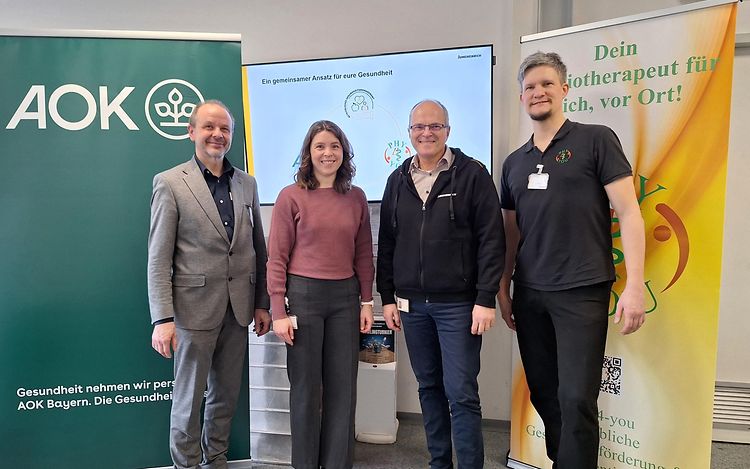
Moosburg and Degernpoint also have an active occupational safety culture and have been working intensively on further developing safety for several years. The results are impressive: thanks to various measures, the number of accidents at both plants has been reduced by 80 per cent. The team focuses on the early identification of hazard sources and open dialogue. Here too, measures such as the introduction of employee committees, safety walks and awareness training raise staff awareness and thus promote accident prevention.
Currently, the wide-ranging ergonomics project “ErgoPro – Ergonomics in Production” is being implemented in Moosburg, which deliberately focuses on awareness and behaviour. This is because analyses from 2024 and 2025 show that many workstations are already very well designed ergonomically, and further improvements in this area are now limited. However, experts on site have also observed that employees tend to adopt incorrect or unnatural postures in their day-to-day work. Consequently, the greatest potential for improvement currently lies in colleagues’ behaviour. The aim of the project is therefore to impart health literacy and embed it practically into everyday working life. Employees should learn to better recognise ergonomic strains and actively counteract them through routines suitable for everyday use and compensatory exercises. This is because every workplace causes one-sided physical strain – not only in production, but also in the office. By further reducing these strains, employees’ quality of life improves in the long term. The project is being implemented in collaboration with an external ergonomics expert and AOK Bayern.